-cropped.svg)
.svg)

- What Revenue Cycle Leaders Are Actually Watching
- What Sets Those Outcomes in Motion
- Why Most Patient Estimate Automation Falls Short
- Good Faith Estimate Compliance and Why It Changes the Calculation
- What Eligibility-Driven Estimate Automation Actually Looks Like
- The Collection Step: How Pre-Payment Changes the AR Picture
- How This Connects to Coverage Intelligence
Executive Summary
Revenue cycle leaders track cash collections, AR days, and net collection ratio because those numbers tell them whether the revenue cycle is working. What those numbers rarely reveal is where the patient-side score was set. For specialty procedural practices, a significant portion of the balances that age past 90 days, the write-offs that drag down the net collection ratio, and the cash that arrives weeks late rather than before the appointment were all determined in the pre-service window, specifically, by whether the practice produced an accurate patient cost estimate, communicated it with enough lead time, and collected payment before the procedure. Automating that sequence is one of the most direct interventions a specialty practice can make on the metrics that matter. But most practices that have tried it have automated the wrong step first, and the result is faster delivery of inaccurate estimates. This piece covers what gets automated, in what order, and why the accuracy of the underlying eligibility data determines whether the automation actually moves the scoreboard.
What Revenue Cycle Leaders Are Actually Watching
A recent Becker's Healthcare piece asked five senior revenue cycle leaders at major health systems to name their favorite KPI. The answers covered daily cash collections, aging AR greater than 90 days, AR days, net collection ratio, and insurance net collection ratio.
What struck me reading it was not which metrics they chose, but what those metrics have in common. Every one of them is an outcome indicator. They tell you whether cash came in, how long it took, and whether you captured what you were owed. They are the scoreboard. What they cannot tell you is where the score was set.
Dan Angel at Baptist Health Care described cash collections as the metric that drives every other major KPI. Blake Evans at Rush University named net collection ratio because it reflects the collective performance of patient access, coding, billing, denial management, and collections. Joanna Caballero at Scripps chose AR days because it is a barometer for the entire revenue cycle. These are thoughtful people looking at the right numbers. The question is what is setting those numbers before they appear on a report.
The Becker's piece was written about health system leaders managing large organizations. But the KPIs they named apply equally to a specialty procedural practice with five physicians and a billing team of three. Cash collections drive the balance sheet. AR days reveal where friction built up. Net collection ratio exposes whether write-offs are hiding operational breakdowns. Those pressures do not scale down with practice size. They concentrate.
What Sets Those Outcomes in Motion
For specialty procedural practices, a substantial portion of the patient-side metrics that revenue cycle leaders track are determined before the patient walks in. Specifically, they are determined by three things that happen in the pre-service window: whether the practice produced an accurate estimate of patient financial responsibility, whether it communicated that estimate with enough lead time for the patient to act on it, and whether it collected payment before care was delivered.
When that sequence is completed before every scheduled procedure, patient balances do not enter the AR cycle in the first place. There is no statement to generate, no follow-up call to make, no write-off decision to take. The cash collections number improves because the cash arrived earlier. AR days improve because the patient balance volume that was feeding the aging buckets has been removed from the cycle. Net collection ratio improves because the write-offs that were dragging it down were prevented rather than managed.
This is what makes patient cost estimate automation a revenue cycle intervention rather than a patient experience feature. The downstream KPI impact is real and measurable. The full pre-service financial clearance workflow from eligibility verification through pre-payment collection, is covered in the patient financial clearance blog. For the vocabulary that defines this territory, including patient cost estimates, pre-payment collection, and financial surprise, Manta's Patient Financial Clearance glossary is the reference.
Why Most Patient Estimate Automation Falls Short
Most practices that have tried to automate patient cost estimates started with the payment collection step and worked backward. A digital payment portal is activated. Patients receive a link before their appointment. The link asks for payment. The estimates in that link come from a manual calculation done by a billing coordinator, or from a fee schedule that does not account for the patient's specific benefit configuration.
The automation is real. The accuracy is not. A patient who receives a pre-service payment request for $400 and later gets an Explanation of Benefits showing they owed $220 does not trust the next estimate they receive. A patient who pays $150 upfront and then receives a balance statement for $340 calls to dispute it, occupying exactly the staff time the automation was supposed to free up.
The accuracy problem has a specific source. Patient cost estimates are only as accurate as the benefit data feeding them, and benefit data requires interpretation, not just retrieval. Knowing that a patient has a $2,000 deductible tells you the plan structure. Knowing that the patient has satisfied $1,740 of that deductible as of today, that the procedure carries 20% coinsurance after the deductible, and that the specific Medicare Advantage plan tier the patient holds applies a different coinsurance schedule for outpatient procedural services than for evaluation and management visits — that is the interpretation layer that produces an estimate a patient can actually rely on. As explored in what eligibility verification does and does not tell you, the standard 271 eligibility response confirms that coverage is active. It does not do this interpretive work automatically.
Good Faith Estimate Compliance and Why It Changes the Calculation
The No Surprises Act introduced a Good Faith Estimate requirement that is reshaping how practices think about pre-service cost communication. Under the rule, providers are required to give uninsured and self-pay patients a written Good Faith Estimate of expected charges before scheduled services. For insured patients, CMS price transparency guidance and state-level requirements are moving in the same direction, toward documented, patient-specific cost communication before care is delivered.
For specialty procedural practices, Good Faith Estimate compliance introduces an administrative obligation that was not previously formalized. A practice that produces estimates manually on a case-by-case basis may satisfy the requirement for some patients while struggling to demonstrate consistent, documented compliance across its full patient volume.
Automated estimate generation tied to verified eligibility and benefit data satisfies the Good Faith Estimate requirement as a byproduct of the workflow rather than as a separate compliance task. The estimate is generated from the patient's actual benefit configuration, documented in the system, and delivered to the patient before the appointment. Compliance is embedded in the process rather than layered on top of it. For practices that have been treating the Good Faith Estimate requirement as a checkbox, the move to automated estimation is the point at which compliance and revenue protection converge.
What Eligibility-Driven Estimate Automation Actually Looks Like
A fully automated patient cost estimate workflow runs through four steps in sequence, all completed before the appointment date.
Benefit retrieval with real-time accumulator data. When a procedure is scheduled, the system queries the patient's payer for verified benefit details including deductible structure, current accumulator status, coinsurance percentage, copay amounts, out-of-pocket maximum progress, and any plan-specific rules affecting cost-sharing for the CPT codes on the schedule. For injectable or infused medications, the system identifies whether the drug falls under the medical benefit or the pharmacy benefit, which can produce materially different patient responsibility figures for the same drug. This step requires real-time data, not cached benefit information from a prior eligibility check that may be weeks old.
Procedure-specific cost calculation. The system applies the verified benefit data to the specific procedure being scheduled, calculating the patient's estimated financial responsibility with enough specificity to reflect plan-tier variations and accumulator status. The calculation happens automatically, without staff involvement, and produces a patient-specific estimate rather than a fee-schedule average.
Automated estimate delivery. The estimate is formatted into a plain-language patient communication and delivered via SMS or email, timed several days before the appointment rather than the day before. The timing matters because patients who receive an estimate with adequate lead time are more likely to review it, ask questions if needed, and complete payment before the appointment. An estimate that arrives 24 hours before the procedure creates urgency but not trust.
Digital pre-payment collection. The estimate communication includes a payment link that accepts card, ACH, or tap-to-pay. Payment is collected and recorded automatically. Once payment is received, the case is marked financially cleared. Cases that have not been cleared by a defined threshold before the appointment are flagged for follow-up, with a defined escalation path for patients who have questions or need a payment arrangement.
Each step in this sequence depends on the accuracy of the previous one. Benefit retrieval that is incomplete produces calculation errors. Calculation errors produce estimate disputes. Estimate disputes undermine payment collection. The workflow is only as strong as its data foundation.
The Collection Step: How Pre-Payment Changes the AR Picture
When a specialty practice completes the estimate automation sequence above before every scheduled procedure, the effect on the AR picture is structural rather than incremental.
Patient balances that are collected pre-service do not enter the AR cycle. They are not included in the accounts receivable aging calculation because they were not receivables; they were payments received before the service was delivered.
AR days improve because the volume of patient balances feeding the aging buckets has been reduced. The balances that do enter the cycle, primarily those from patients with complex coverage situations or extraordinary circumstances, are genuinely difficult collections rather than routine balances that could have been collected upfront.
The net collection ratio effect follows the same logic. Write-offs that result from aged patient balances are prevented rather than managed, because the balances that would have aged were collected before they could. A specialty practice that collects 80% of patient responsibility pre-service and loses the remaining 20% to a mix of payment plans and write-offs will consistently outperform a practice that attempts to collect 100% post-service and achieves 50% after write-offs.
The Becker's leaders who named AR days and net collection ratio as their most important KPIs understand this dynamic at scale. Northstar Medical Management experienced it directly at the specialty practice level, where resolving patient financial responsibility before procedures reduced the downstream collection friction that had previously consumed billing team time and contributed to aging balances across their case volume.
How This Connects to Coverage Intelligence
Patient cost estimate automation is not a standalone capability. It is the patient-side output of the coverage intelligence layer that sits between clinical scheduling and billing operations.
The benefit data that drives accurate estimate generation is the same benefit data that drives eligibility verification and prior authorization scoping. When that data is retrieved once and used across all three functions, including confirming coverage, scoping authorization requirements, and calculating patient responsibility, the workflow is efficient and the outputs are consistent. When patient estimate generation runs on separate data from a separate eligibility check at a separate point in the workflow, the estimates are less accurate, more expensive to produce, and more likely to require correction after the fact.
Coverage Intelligence is the category that describes this integrated layer. Patient cost estimate automation is one of its outputs. The practices that benefit most from the automated estimate workflow are those that have built, or are building, the broader coverage intelligence infrastructure that makes the underlying data accurate enough to trust.
Final Thoughts
The revenue cycle leaders quoted in the Becker's piece are watching the right scoreboard. Cash collections, AR days, net collection ratio. These are the metrics that reveal whether the revenue cycle is working. What the scoreboard does not show is where the score is set.
For specialty procedural practices, a significant portion of the patient-side score is set in the pre-service window, by whether an accurate cost estimate was produced, communicated, and collected before the procedure. Automating that sequence is the intervention that moves the scoreboard before the game is played, rather than analyzing the result after it is over.
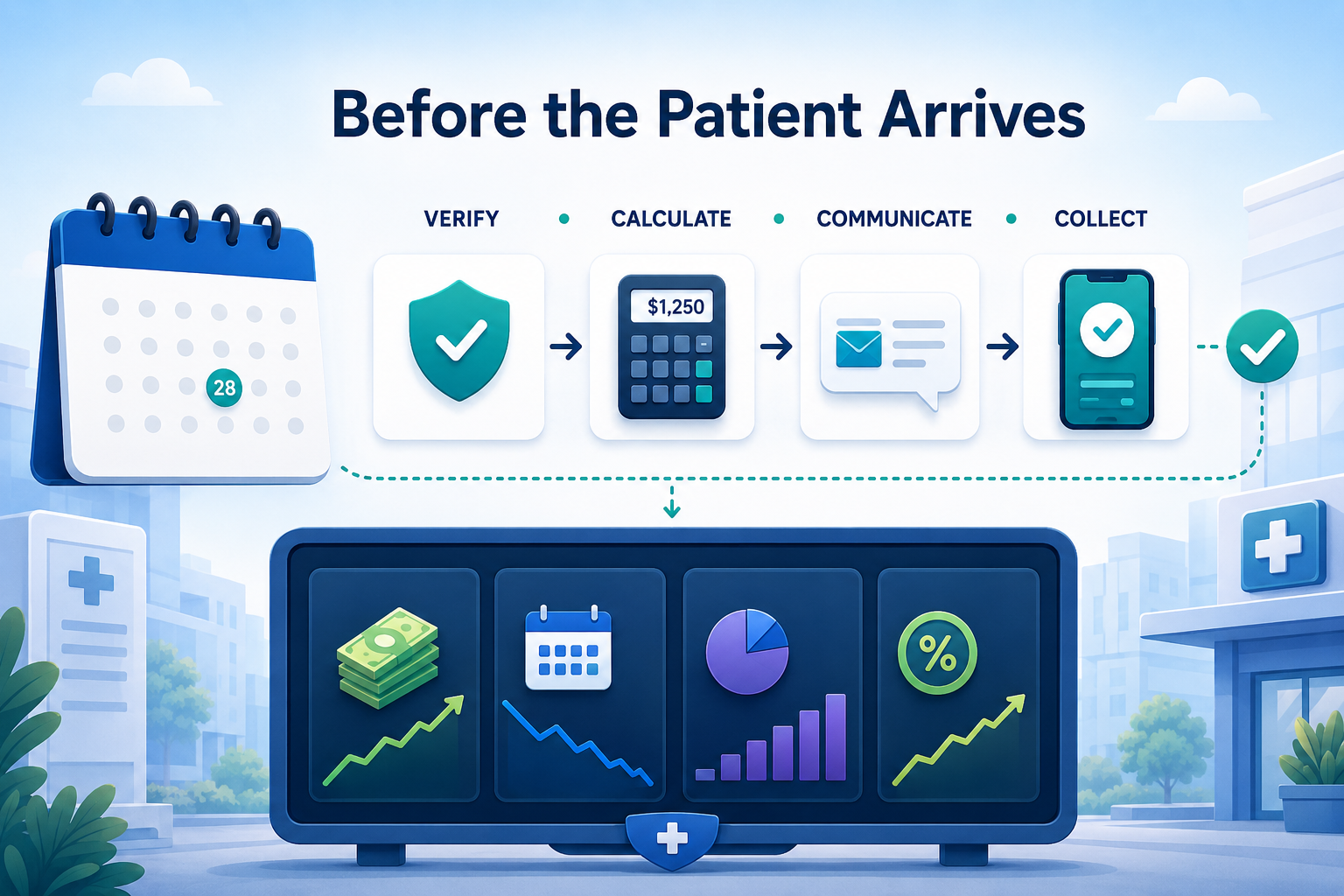
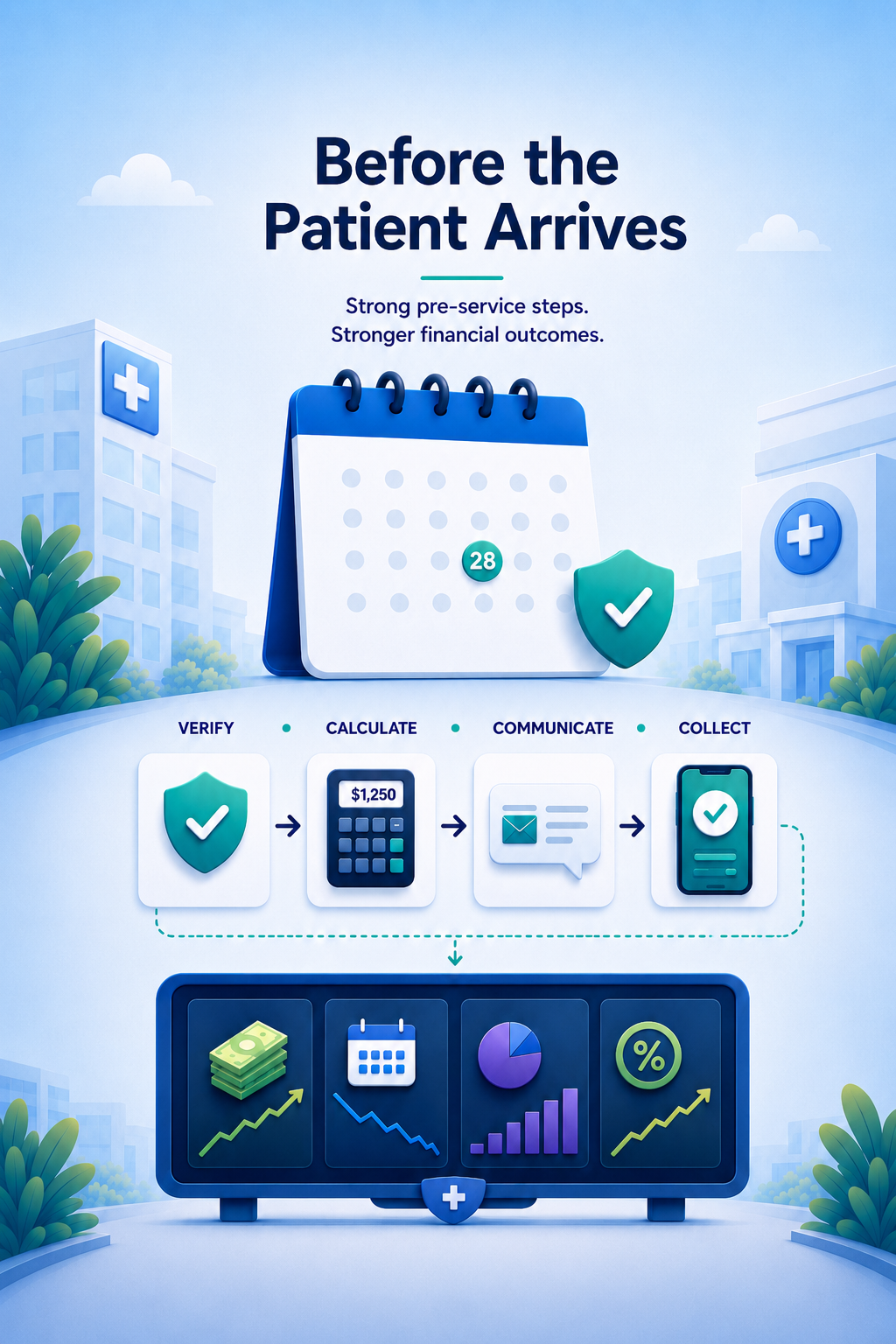
The practices that get there are not the ones with the most sophisticated payment portals. They are the ones that recognized the estimate accuracy problem before the payment collection problem, built the eligibility-driven interpretation layer underneath estimate generation, and completed the full sequence before the patient arrived: verify, calculate, communicate, collect. That sequence produces better AR days, stronger net collection ratios, and fewer write-offs for the same reason that any upstream intervention outperforms its downstream counterpart. It addresses the cause before the cause becomes a consequence.
Want to see how Manta automates patient cost estimates from verified eligibility data? Book a demo.