-cropped.svg)
.svg)


- The Revenue Gap That Prior Authorization Doesn't Close
- What Patient Financial Clearance Actually Is
- Why the Patient Side of Revenue Is Harder to Protect
- The No-Show Problem and What It Reveals
- The Cost of Getting the Timing Wrong
- What an Effective Pre-Service Financial Clearance Workflow Looks Like
- How Patient Financial Clearance Connects to Coverage Intelligence
- What Practices Get Wrong About Patient Collections
Executive Summary
Patient financial clearance is the process of calculating, communicating, and collecting a patient's financial responsibility before care is delivered. For specialty procedural practices, it is the revenue protection function that prior authorization alone cannot complete. A practice can hold a confirmed payer authorization for every scheduled procedure and still lose revenue to patient no-shows, balance disputes, and uncollectable post-treatment write-offs when the patient's financial commitment has not been secured in advance. Closing that gap requires a pre-service financial clearance workflow that treats patient responsibility the same way prior authorization treats payer responsibility: as something to be confirmed, documented, and resolved before the appointment, not after it.
The Revenue Gap That Prior Authorization Doesn't Close
Specialty practices spend considerable effort, and increasingly considerable technology investment, on the payer side of pre-service revenue protection. Authorization requirements are determined. Documentation is assembled. Submissions are tracked. Denials are appealed. That work is necessary and the operational discipline behind it is real.
What receives far less systematic attention is the patient side of the same equation. A 2026 KFF poll found that 32% of insured adults describe prior authorization requirements as their single greatest burden in navigating the healthcare system, ranking above billing complexity, appointment access, and finding in-network providers. Patients are acutely aware of the financial dimensions of their care, and yet most specialty practices do not resolve the patient's financial responsibility with the same rigor they apply to the payer's authorization.
The gap that creates is specific and measurable. A procedure with confirmed prior authorization can still result in a no-show from a patient who was never asked to make a financial commitment. A case cleared with the payer can still generate a post-treatment balance that takes months to collect or is ultimately written off. Payer authorization protects revenue from one direction. Patient financial clearance protects it from the other. For a detailed definition of what patient financial clearance involves and the vocabulary that surrounds it, see Manta's Patient Financial Clearance glossary.
What Patient Financial Clearance Actually Is
Patient financial clearance is not a billing function. It is a pre-service function, and the distinction determines where it belongs in the care workflow and who is responsible for completing it.
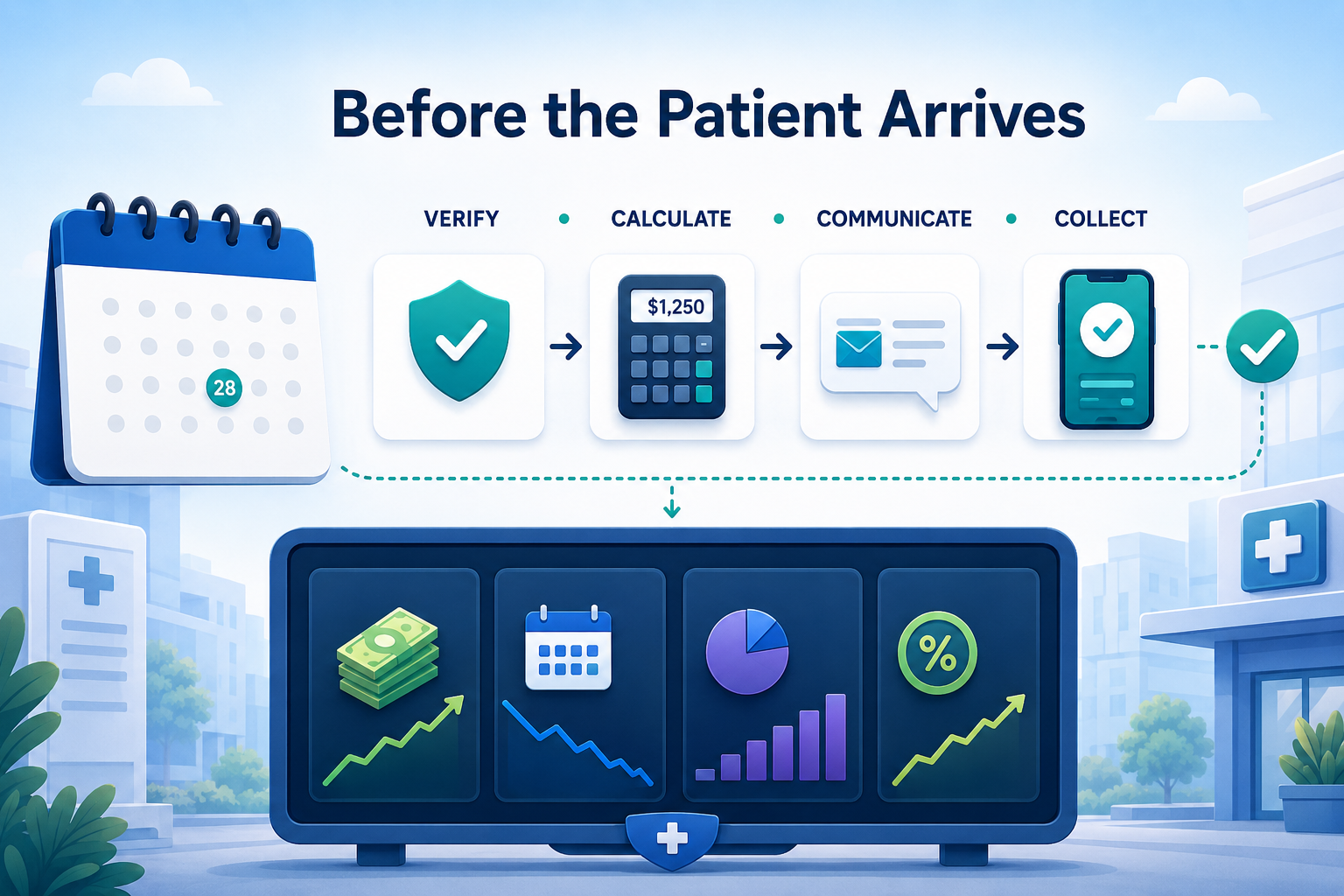
The process has three components. The first is calculation: determining what the patient owes based on verified eligibility, confirmed benefit details, and correct application of plan-specific cost-sharing rules including deductible accumulation, coinsurance, copay, and out-of-pocket maximum status. The second is communication: presenting the patient with an accurate estimate of their responsibility before the appointment, with enough time for them to make an informed decision about proceeding. The third is collection: securing payment or a confirmed payment commitment before care is delivered.
All three components must be completed for financial clearance to be effective. A practice that calculates patient responsibility accurately but does not communicate it in advance has done the analytical work without producing the outcome. A practice that communicates an estimate but does not collect before treatment has informed the patient without securing a financial commitment. The revenue protection value of patient financial clearance comes from completing the full sequence before the appointment, not from completing any single step in isolation. Understanding where this fits in the broader coverage lifecycle helps clarify why this sequence matters and where it sits relative to eligibility verification and prior authorization.
Why the Patient Side of Revenue Is Harder to Protect
Payer revenue protection has a defined workflow. Authorization requirements are either met or they are not. Approval is granted or denied. The outcome is binary and the feedback, while sometimes delayed, is eventually unambiguous.
Patient financial responsibility does not work the same way. The calculation depends on benefit details that change mid-year as deductibles accumulate. It requires distinguishing between drug benefit and medical benefit cost-sharing for injectable or infused medications, which matters enormously for ophthalmology and GI practices managing injection protocols. It requires accounting for secondary coverage, coordination of benefits rules, and plan-specific variations that make the same procedure carry different patient cost implications depending on which plan tier the patient holds.
These are interpretation challenges. The arithmetic of patient cost-sharing is simple. The difficulty is in obtaining accurate, current benefit data and applying it correctly to each case. When that interpretation is done late, or not at all, the practice does not discover the gap until the patient receives a statement that does not match their expectations, a balance sits unpaid, or a no-show removes the revenue opportunity entirely.
The No-Show Problem and What It Reveals
No-shows in specialty procedural practices are not primarily a scheduling problem. They are a financial commitment problem. A patient who has made no financial investment in an upcoming appointment has no financial stake in keeping it. A patient who has paid their estimated copay or deductible before the procedure has converted a scheduling confirmation into a financial transaction, and financial transactions have significantly higher follow-through rates than calendar entries.
The data on this is consistent. Practices using pre-service financial clearance with automated pre-payment collection report up to 25% fewer cancellations as a direct result of upfront financial commitment. That number reflects something straightforward about patient behavior: when patients pay in advance, they arrive. When they do not, cancellation is frictionless.
For specialty procedural practices, where a cancelled surgical case or a missed injection appointment represents thousands of dollars of lost clinical capacity, the no-show rate is not an inconvenience metric. It is a revenue metric, and it responds directly to whether the practice secured a financial commitment at scheduling or left the appointment as a low-stakes calendar entry the patient could abandon without consequence.
The same dynamic appears in Manta's own customer data. Northstar Medical Management, a surgical practice managing high-volume prior authorization and pre-service financial clearance workflows, found that resolving patient financial responsibility before procedures significantly reduced the downstream collection friction that had previously consumed billing team time across their case volume.
The Cost of Getting the Timing Wrong
The revenue impact of incomplete patient financial clearance shows up in three specific places, and all three trace back to the same root cause: the financial conversation happening too late.
The first is no-shows. A patient who has made no financial investment in an upcoming appointment has no financial stake in keeping it. Cancellation is frictionless. For specialty procedural practices, where a cancelled surgical case or a missed injection appointment represents thousands of dollars of lost clinical capacity, no-show rate is not an inconvenience metric. It responds directly to whether the practice secured a financial commitment at scheduling.
The second is post-treatment collection overhead. When patient responsibility is not resolved before the appointment, it becomes a collections problem after it. Statements go out weeks after the date of service. Patients dispute balances they were not prepared for. Staff time is consumed by follow-up calls on balances that could have been collected in a two-minute digital transaction before the procedure ever took place.
The third is write-offs. Balances that age become harder to collect at a rate that is well documented across the industry. A balance collected before treatment costs the practice nothing beyond the infrastructure to collect it. A balance pursued 90 days after treatment costs staff time, collection overhead, and often results in a partial recovery or a full write-off. The difference between those two outcomes is almost entirely a function of when in the patient journey the practice chose to have the financial conversation.
What an Effective Pre-Service Financial Clearance Workflow Looks Like
A complete patient financial clearance workflow for a specialty procedural practice has five operational steps, all completed before the appointment date.
- Benefit verification with cost-sharing calculation. Eligibility is verified and benefit details are pulled in enough depth to calculate patient responsibility accurately. This means deductible accumulation status, coinsurance percentage, copay amounts, out-of-pocket maximum progress, and any plan-specific rules that affect cost-sharing for the specific procedure being scheduled.
- Patient responsibility estimate generation. The patient's estimated financial responsibility is calculated from the benefit data and formatted into a clear, plain-language estimate. The estimate should distinguish between what the payer is expected to cover and what the patient is expected to pay, including any amounts that may vary based on final claim processing.
- Pre-service patient communication. The estimate is delivered to the patient via automated SMS or email before the appointment, with enough lead time for the patient to review it, ask questions, and make a payment decision. Communication that arrives the day before the appointment is not pre-service clearance. It is a last-minute notification that creates friction rather than resolving it.
- Pre-payment collection. Payment is collected through a digital payment link that accepts card, ACH, or tap-to-pay, without requiring a phone call or an in-person interaction. The payment is recorded automatically and associated with the case. Practices that require staff to manage this outreach manually are adding labor cost to a process that should be automated.
- Confirmation and case clearance. Once payment is received, the case is marked financially cleared. Cases that are not cleared before the appointment date are flagged for review, with a defined escalation path for patients who have questions about their estimate or need a payment arrangement.
This sequence, completed before every scheduled procedure, eliminates the post-treatment collection cycle for the majority of patient balance volume. Balances that do require follow-up are exceptions, not the standard workflow.
How Patient Financial Clearance Connects to Coverage Intelligence
Patient financial clearance is the patient-side component of Coverage Intelligence, the complete pre-service revenue protection layer that covers payer eligibility verification, prior authorization, and patient financial clearance before care is delivered.
The connection is structural. Prior authorization secures the payer's commitment to reimburse. Patient financial clearance secures the patient's commitment to pay their portion. Neither is sufficient without the other. A practice that completes payer authorization without completing patient financial clearance has protected revenue from one direction only.
The most effective pre-service revenue protection workflows address both simultaneously, using the same eligibility and benefit data that drives authorization determination to also drive patient cost-sharing calculation. When the coverage data is already being retrieved for authorization purposes, generating an accurate patient cost estimate requires no additional data collection, only the intelligence to apply that data correctly to the patient's specific benefit configuration.
What Practices Get Wrong About Patient Collections
The most common error in patient financial management is not a process failure. It is a timing failure. Practices that treat patient collections as a billing function are solving the problem at the wrong point in the care journey, under the worst possible conditions for both the practice and the patient.
Post-treatment collection has three structural disadvantages. The patient's motivation to pay has declined because the service has already been delivered and the perceived value of the appointment is in the past. The practice's leverage is at its lowest point because the service cannot be withheld. And the balance has often aged by the time a statement reaches the patient, because claim processing, explanation of benefits delivery, and statement generation add weeks between the date of service and the moment the patient sees a bill.
Practices that shift patient financial responsibility resolution to the pre-service window operate under exactly the opposite conditions. The patient's motivation is high because they want the procedure to proceed. The practice's leverage is at its greatest because the appointment has not yet occurred. And the resolution happens in real time, before any aging occurs.
The shift is not primarily a technology question, though automation makes it scalable. It is a workflow sequencing question, a decision about where in the patient journey the financial conversation belongs. Practices that have made that decision clearly, and built their workflows accordingly, consistently outperform their peers on patient collection rates, no-show rates, and write-off volumes. How this fits into the broader pre-service revenue protection architecture is explained in detail in the Coverage Intelligence cornerstone blog.
Final Thoughts
Specialty practices have spent years building payer-side revenue protection infrastructure. The category of tools, workflows, and vendor solutions around prior authorization has matured considerably, and practices that have invested in it have measurably better payer denial rates as a result.
The patient side of the same equation has received far less systematic attention, and the cost of that gap is visible in no-show rates, post-treatment collection overhead, and write-off volumes that most practices accept as a normal cost of doing business. They are not a normal cost. They are the predictable consequence of resolving patient financial responsibility at the wrong point in the care journey.
Patient financial clearance, completed before the appointment rather than after the claim, changes the conditions under which the financial conversation happens. It gives the patient time to understand their responsibility and make an informed decision. It gives the practice a confirmed financial commitment before clinical capacity is consumed. And it eliminates the post-treatment collection cycle for the majority of patient balance volume by resolving the question at the moment when both parties are most motivated to reach a clear answer.
Prior authorization protects revenue from the payer. Patient financial clearance protects it from the patient. Coverage Intelligence is complete when both are in place.
Ready to close the patient-side revenue gap? See how Manta's pre-service financial clearance workflow protects specialty practice revenue from both directions.