-cropped.svg)
.svg)


- What CMS-0057-F Actually Requires
- Who It Covers — and Who It Doesn't
- The Two-Phase Compliance Timeline
- What Faster Payer Response Times Mean in Practice
- The Prior Authorization API: What It Changes for Specialty Workflows
- The CMS-0057-F Readiness Gap Formula
- The Implementation Reality: Why Payer Readiness Will Be Uneven
- What Specialty Practices Should Do Before January 2027
- The Regulatory Signal — and What It Confirms
Executive Summary
CMS-0057-F, the CMS Interoperability and Prior Authorization Final Rule, requires Medicare Advantage organizations, Medicaid managed care plans, CHIP programs, and qualified health plan issuers to implement FHIR-based APIs for prior authorization by January 1, 2027. Payer response timeframe requirements, including 72-hour turnaround for urgent requests and 7 calendar days for standard requests, took effect January 1, 2026. For specialty practices, the regulation changes the prior authorization environment but does not resolve the underlying workflow challenge. The practices best positioned to benefit are those building the coverage intelligence infrastructure now, before payer API readiness determines whether they can act on it.
What CMS-0057-F Actually Requires
Issued January 17, 2024, CMS-0057-F is the federal government's most comprehensive effort to standardize and accelerate prior authorization across the major payer categories. The rule has two distinct layers.
- The first is process reform. Covered payers must respond to prior authorization requests within defined timeframes: 72 hours for urgent cases, 7 calendar days for standard requests. When they deny a request, they are required to provide specific, detailed reasons, not generic language that leaves providers guessing about what documentation might have secured approval. These provisions took effect January 1, 2026, and represent what CMS described as a 50% improvement in response times for some payers.
- The second layer is infrastructure. By January 1, 2027, covered payers must implement a suite of HL7 FHIR-based APIs: a Prior Authorization API that identifies services requiring authorization, communicates documentation requirements, and supports electronic submission and response; a Provider Access API that gives providers access to patient claims, encounter, and prior authorization data; a Payer-to-Payer API for data exchange between health plans; and an expanded Patient Access API that includes prior authorization information. Together, these APIs are designed to move prior authorization from a phone-and-fax workflow to a digitally integrated one.
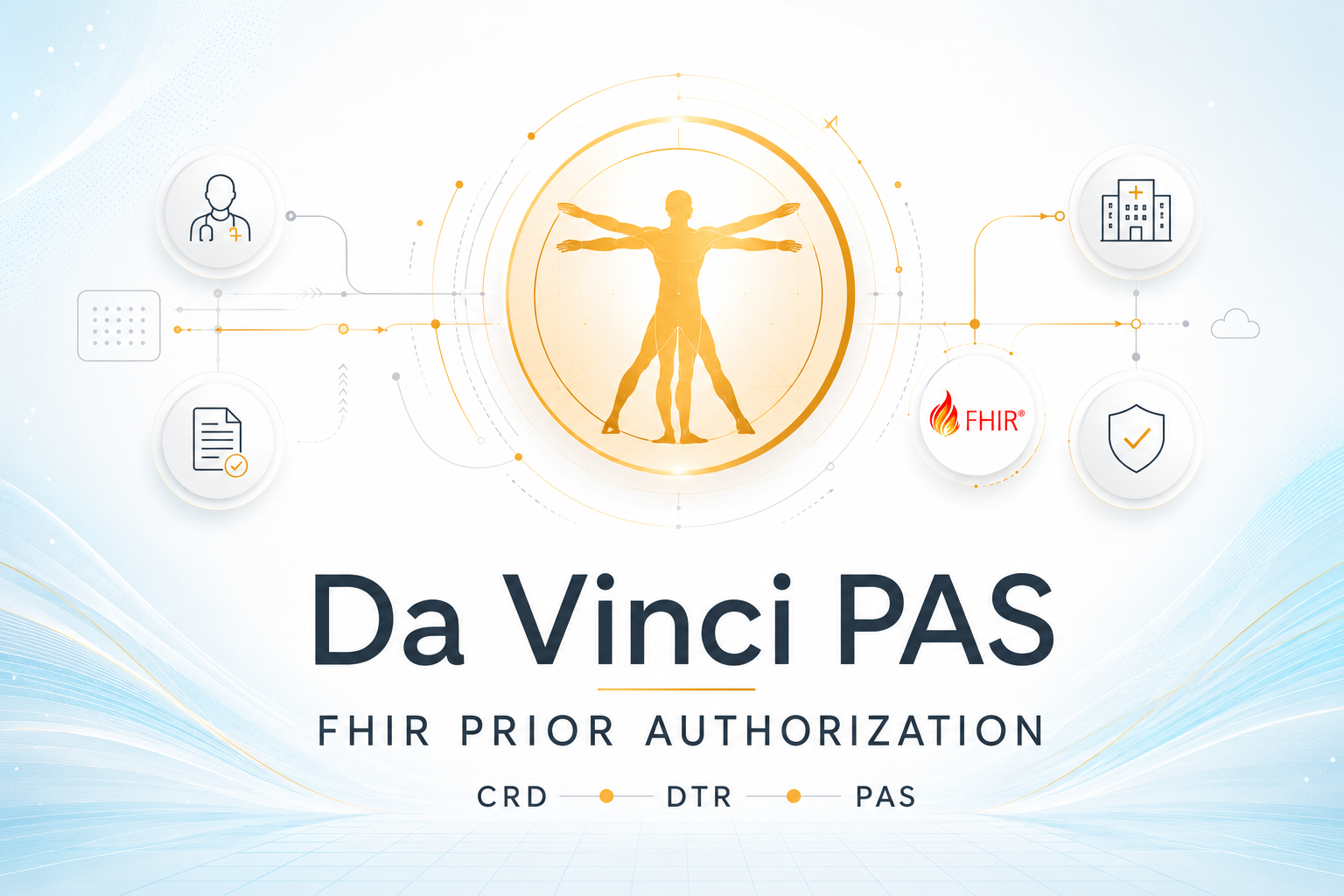
The CMS-0057-F regulatory framework builds on and extends the Da Vinci Project's Prior Authorization Support (PAS) implementation guide, which defines how FHIR resources map to prior authorization request and response workflows. For specialty practices with EHR systems that can connect to these APIs, the promise is significant: authorization determinations that flow directly into clinical workflows, without manual portal submissions or fax confirmation cycles.
For context on how the broader regulatory shift toward Medicare prior authorization is developing, including CMS's WISeR pilot introducing PA requirements into Original Medicare FFS, see Medicare Is Introducing Prior Authorization — That Changes More Than Policy.
Who It Covers — and Who It Doesn't
The rule applies to Medicare Advantage organizations, state Medicaid and CHIP fee-for-service programs, Medicaid managed care plans, CHIP managed care entities, and qualified health plan issuers on federal and state health insurance exchanges.
Traditional Medicare fee-for-service is not covered. Neither are employer group health plans or self-insured plans.
For specialty practices such as ophthalmology, GI, orthopedics, ENT, radiology, and surgery centers, this scope matters significantly. These practices typically carry a payer mix weighted toward Medicare Advantage, with meaningful Medicaid exposure and commercial plan volume alongside it. The majority of their payer relationships fall within the rule's scope. Where practices have historically faced the greatest prior authorization friction, in Medicare Advantage plans with dense, variable documentation requirements, CMS-0057-F applies directly.
The Two-Phase Compliance Timeline
Understanding CMS-0057-F requires separating its two compliance horizons, because they carry different operational implications.
January 1, 2026 — Process requirements in effect. Covered payers must meet the 72-hour and 7-day response timeframes. Denial explanations must be specific and actionable. Payers must begin reporting prior authorization metrics to CMS annually. These provisions are already active.
January 1, 2027 — API requirements in effect. Medicare Advantage organizations and state Medicaid and CHIP FFS programs must have all five FHIR APIs live. Medicaid managed care plans and CHIP managed care entities must comply beginning with their first rating period on or after January 1, 2027. QHP issuers on federal exchanges must comply beginning with the first plan year on or after January 1, 2027. MIPS-eligible clinicians begin the Electronic Prior Authorization attestation measure under the Promoting Interoperability performance category during the CY 2027 performance period — an attestation requirement that asks clinicians to confirm they are using certified health IT to request and receive prior authorization decisions electronically, rather than through manual channels.
The two phases are sequential but connected. The process requirements establish behavioral standards for payers now. The API requirements establish the technical infrastructure that makes those standards enforceable and scalable by 2027.
What Faster Payer Response Times Mean in Practice
The 72-hour and 7-day response timeframe requirements are the most immediately tangible change for specialty practices. Prior authorization turnaround has historically been one of the most disruptive variables in scheduling and care delivery. Unpredictable wait times make it difficult to book procedures confidently, manage clinical staff, and give patients reliable timelines.
Mandatory response windows don't eliminate the prior authorization step. They impose a ceiling on how long payers can delay a determination. For practices that currently track authorization status manually, through spreadsheets, portal logins, and phone follow-up, a faster payer response only helps if the practice has the infrastructure to act on that response quickly. A 72-hour payer decision that sits in a portal unnoticed for three more days produces the same scheduling delay as a five-day payer decision.
This is where the authorization delay problem often actually lives. Not in the payer's processing time, but in the gap between the payer's decision and the practice's awareness of it. Addressing that gap requires real-time status tracking and automated notification at the practice level — the coverage intelligence infrastructure that makes faster regulatory timeframes actionable rather than theoretical. The upstream origins of that delay are examined in The Coverage Lifecycle: Where Healthcare Revenue Actually Breaks.
The Prior Authorization API: What It Changes for Specialty Workflows
The Prior Authorization API is the most consequential technical requirement in CMS-0057-F for specialty practices. When fully implemented, it replaces fax submissions and portal logins with a direct, machine-readable connection between the practice's EHR and the payer's authorization system.
In practical terms: a physician orders a procedure. The EHR queries the payer's Coverage Requirements Discovery (CRD) service, part of the Da Vinci implementation framework, to determine whether prior authorization is required. If it is, the Documentation Templates and Rules (DTR) service provides the specific documentation requirements for that payer and procedure. The practice then submits the authorization request electronically through the Prior Authorization Support (PAS) workflow, and the payer responds within the regulatory timeframe, with the determination flowing back into the EHR.
That workflow, when it functions as designed, compresses a process that currently consumes an average of 22 minutes of staff time per authorization into something closer to automated verification. Given that prior authorization consumes an average of 14 hours of staff time per week per physician, at an administrative cost of $23,000 per physician per year, the efficiency case is substantial.
What the API does not do is remove the need for accurate, complete documentation. A faster submission channel carrying incomplete clinical information still produces a denial. The intelligence layer, knowing what each payer requires for each CPT code and ensuring documentation is assembled correctly before submission, remains the determinant of whether the electronic workflow succeeds or generates a rework cycle. The structural gap this fills in the existing technology stack is examined in The Missing Layer in Your Revenue Cycle Technology Stack.
The CMS-0057-F Readiness Gap Formula
The regulation's benefit is not automatic. It depends on two variables that move independently of each other.
Practice Benefit = (Payer API Readiness × Practice Coverage Intelligence Capability) − Legacy Workflow Drag
Legacy Workflow Drag = Manual PA Submissions + Fax/Portal Dependencies + Staff Interpretation Burden
When either variable approaches zero, the formula's output collapses. A practice with strong coverage intelligence capability but a payer that hasn't completed API implementation still processes authorizations through legacy channels. A practice whose payer completes API implementation on schedule but whose internal workflows remain manual and staff-dependent cannot operationalize the faster data.
The formula clarifies where practices have leverage. Payer API readiness is outside their control. Practice coverage intelligence capability is not. The practices that invest in the intelligence layer before 2027, covering real-time eligibility, automated PA determination, documentation preparation, and denial management, are positioned to capture the regulation's benefit on day one of compliance. Those that wait are dependent on a payer readiness timeline they cannot influence.
The Implementation Reality: Why Payer Readiness Will Be Uneven
The January 2027 deadline is firm on paper. In practice, payer implementation will be uneven, and the gap between regulatory compliance and functional API integration will be wider for some payers than others.
As of early 2026, over half of providers and a significant share of payers had not yet begun working on the API requirements the rule mandates. Building FHIR-based APIs for prior authorization is not a minor technical lift. It requires payers to translate existing EDI X12 278 transaction workflows into FHIR-compatible resources, establish endpoint connectivity with EHR systems across thousands of provider organizations, and maintain those integrations as clinical documentation standards evolve.
The more candid assessment from implementation experts is that payers may have some APIs live by January 2027 while still relying on web portals and legacy fax workflows for substantial portions of their prior authorization volume. The mandate will advance the transition. It will not complete it.
For specialty practices with a concentrated Medicare Advantage payer mix, this matters because the payers covering the majority of their authorization volume are the ones whose API readiness will most directly determine whether CMS-0057-F changes their day-to-day workflows. A practice that has spent the past year building manual workarounds around incomplete payer systems will find the 2027 transition more disruptive, not less. The persistent nature of that authorization burden across specialty settings is detailed in How Specialty Practices Eliminate Prior Authorization Delays — Not Manage Them.
What Specialty Practices Should Do Before January 2027
The practices that will benefit most from CMS-0057-F are building their coverage intelligence capability now, not scheduling that project for late 2026.
Several concrete steps apply across the specialty practice segment.
- Assess your payer mix against the rule's scope. Identify which of your top payers by authorization volume are subject to CMS-0057-F. Medicare Advantage plans, Medicaid managed care organizations, and QHPs on the exchanges are covered. Understand which of those payers have published API roadmaps and what their stated timelines are, and build contingency workflows for those that haven't.
- Pressure-test your technology vendor's readiness. Ask your EHR vendor for a specific CMS-0057-F integration roadmap, not a general commitment to interoperability. Ask which payers they have completed FHIR API connectivity with, and when they expect coverage of your top five payers by authorization volume. Vague answers are informative.
- Audit your current authorization workflow against what the API environment will require. When the Prior Authorization API is live, the practices that benefit will be those whose internal processes can receive and act on electronic determinations without a manual handoff. If your current workflow depends on a staff member logging into a portal, printing a determination, and entering it into a separate system, the API removes one step but not the bottleneck.
- Build the coverage intelligence layer that makes API data actionable. Real-time PA requirement determination per CPT code and payer, automated documentation assembly, denial management with autonomous appeals: these capabilities make CMS-0057-F an accelerant rather than an arrival. Without them, the regulation changes the channel through which prior authorization flows but not the friction it creates. For the vocabulary and framework that defines this layer, see Manta's Coverage Intelligence glossary.
The Regulatory Signal — and What It Confirms
CMS-0057-F is worth understanding not just as a compliance deadline but as a directional signal about where the prior authorization system is heading.
The regulation exists because the problem it addresses is severe enough to require federal intervention. The AMA's prior authorization surveys have documented for years what specialty practices experience directly: 14 hours of staff time per week per physician consumed by authorization administration, 15% or more of claims denied due to missed authorizations, and 10% of patients abandoning care because authorization delays make treatment inaccessible. Those numbers were the evidentiary basis for the rule.
What the regulation confirms is that prior authorization complexity is structural, and that the healthcare system has acknowledged it cannot be resolved by asking practices to add more staff or submit more carefully. The mandate for payer-side API infrastructure is an acknowledgment that the information gap between payers and providers is the root cause, and that closing it requires architectural change, not process improvement.
For specialty practices, the confirmation matters because it validates the investment case for the coverage intelligence layer. The regulatory environment is moving in the direction that Coverage Intelligence addresses. That movement will not stop at January 2027.
Final Thoughts
CMS-0057-F is the most significant federal prior authorization reform in a generation. For specialty practices, its practical impact will depend entirely on two things: how ready their payers are, and how ready they are.
The payer side of that equation is outside any practice's control. The practice side is not. The 72-hour response window means nothing to a practice that can't act on a determination in real time. The Prior Authorization API delivers no efficiency to a practice whose internal workflow still depends on manual data entry and staff interpretation.
The window between now and January 2027 is not a waiting period. It is the build period, the time to assess vendor readiness, audit internal workflows, and construct the coverage intelligence infrastructure that turns a regulatory compliance date into a genuine operational advantage. The practices that use it well will enter 2027 positioned to benefit. The ones that don't will spend 2027 catching up.
Ready to build the coverage intelligence layer before the deadline? See how Manta's platform prepares specialty practices for the CMS-0057-F environment → Book a demo